Nickel-Titanium (Nitinol) is a revolutionary super elastic and shape memory alloy (SMA) known for its extraordinary ability to “remember” its original shape and withstand massive deformation. Combining roughly equal atomic percentages of nickel and titanium, this smart material has become a cornerstone in minimally invasive medical devices, aerospace actuators, and high-performance industrial engineering. As a leading global supplier, we provide high-purity Nitinol profiles, components, and atomized powders compliant with strict international medical standards, including ASTM F2063 and ISO 13485 quality management frameworks.
1. Core Mechanisms: How Nitinol Works
Nitinol’s unique properties stem from a reversible, solid-state phase transformation between two distinct crystal structures:
- Austenite: The high-temperature phase. It features a rigid, cubic crystal structure (B2). In this state, Nitinol is strong and highly resistant to permanent deformation.
- Martensite: The low-temperature phase. It features a flexible, monoclinic crystal structure (B19′). In this state, the material can be easily deformed without breaking.
1.1 Shape Memory Effect (SME) vs. Superelasticity (SE)
Depending on the working temperature relative to the material’s Transformation Temperature (Af – Austenite Finish), Nitinol exhibits two primary behaviors:
- Shape Memory Effect (Thermal): At room temperature (in its Martensite phase), you can bend or deform the Nitinol. When heated above its Af temperature, it instantly snaps back to its original pre-set Austenite shape.
- Superelasticity (Mechanical): At temperatures above Af, the material is already fully Austenite. Applying stress forces it into a “stress-induced martensite” state. The moment the stress is released, it unloads back to Austenite, recovering up to 8% to 10% elastic strain (compared to less than 1% for standard stainless steel).
1.2 Nitinol Core Mechanisms & Industry Applications At-a-Glance
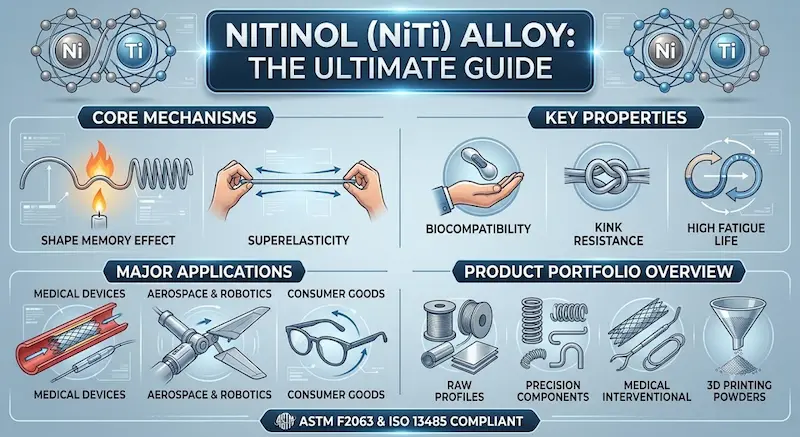
The infographic below visually integrates the fundamental science and practical applications of Nitinol. It details the reversible crystal structure transformation (Austenite vs. Martensite) that drives both Shape Memory Effect and Superelasticity, lists the key physical properties (like density and tensile strength), and maps them directly to dynamic medical implants, aerospace actuation, and unbreakable consumer goods.
1.3 Advanced Nitinol Processing: Surface Finishes & Custom Shape Setting
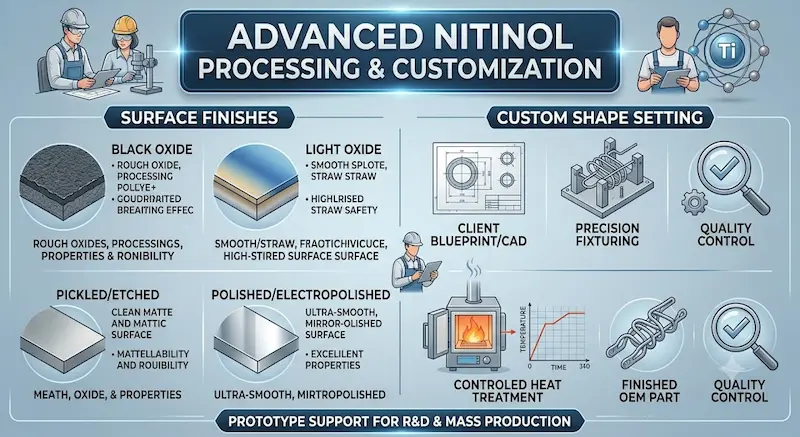
Nitinol is not a “one-size-fits-all” material. Its dynamic fatigue life and chemical stability are determined by advanced processing. This diagram explains two critical technical dimensions:
- SURFACE FINISHES: Comparing dynamic oxide layers (Black/Light) with stripped (Pickled) and mirror-like (Electropolished) surfaces, explaining their unique advantages for friction control vs. biocompatibility.
- CUSTOM OEM WORKFLOW: Detailing how we program your CAD/Blueprint geometry into a finished 3D component via precision fixturing and controlled heat-treatment.
2. Technical Capabilities & Material Specifications
Understanding the precise metallurgical and mechanical boundaries of Nitinol is essential for successful product development. We manufacture under rigorous process controls to deliver predictable behavior across all working conditions.
2.1 Phase Transformation Temperature Matrix
The performance of Nitinol depends on its Transformation Temperature (Af – Austenite Finish). We offer precise tuning to match your environment:
- Superelastic Grade (SE): Standard Af ranges from -15 to 30 degrees Celsius. Ideal for devices operating at or around body temperature, providing immediate elastic recovery.
- Shape Memory Grade (SM): Fully customizable Af ranges from 20 to 95 degrees Celsius. Engineered for thermal actuation where mechanical movement is triggered by environmental or electrical heating.
To choose the right Nitinol for your project, understanding the mechanical bounds and chemical purity is essential:
| Property | Superelastic Grade (SE) | Shape Memory Grade (SM) |
| Typical Af Temperature Range | -15 to 30 degrees Celsius | 20 to 90 degrees Celsius |
| Max Recoverable Strain | 8% to 10% | 6% to 8% (via heating) |
| Ultimate Tensile Strength | 1000 MPa Min | 800 MPa Min |
| Primary Industry | Medical Stents, Orthodontics, Eyeglasses | Thermal Actuators, Industrial Switches, CNC Parts |
2.2 Surface Treatment Options
Surface integrity directly dictates fatigue life and biocompatibility. We provide four industry-standard finishes to meet your exact engineering requirements:
| Surface Finish | Processing Method | Typical Applications |
| Black Oxide | Natural thermal oxide layer formed during heat treatment. | Industrial actuators, heavy-duty springs, robust mechanical linkages. |
| Light Oxide | Controlled thin oxide layer (amber/blue hues) with smooth finish. | Dynamic mechanical components, commercial consumer goods. |
| Pickled / Etched | Chemical acid etching to strip all scale and thermal oxide. | Raw stock for secondary centerless grinding or laser cutting. |
| Polished / Electropolished | Advanced mechanical or electrochemical micro-polishing. | Medical implants (stents, guide wires), maximizing corrosion resistance. |
3. Industry Standards & Quality Assurance
3.1 Medical Device OEMs & Clinical Compliance
For critical interventional applications, structural purity is non-negotiable. Our medical-grade Nitinol strictly adheres to ASTM F2063 (Standard Specification for Wrought Nickel-Titanium Shape Memory Alloys for Medical Devices and Surgical Implants).
Our manufacturing lines comply with ISO 13485 quality systems, ensuring comprehensive traceability from raw vacuum melted ingots to ultra-low inclusion (ELI) micro-wires. This guarantees low oxygen content, minimized non-metallic inclusions, and exceptional microstructural homogeneity to eliminate premature fatigue failure in clinical environments.
3.2 Industrial, Aerospace & Robotics Sector
Beyond medicine, we support aerospace and robotic automation industries with high-fatigue life Nitinol actuators. These parts offer high energy density, silent operation, and replace heavy electromagnetic solenoids in tight spaces.
4. Structural Nitinol Product Portfolio
Our product structure is optimized for efficient sourcing. We categorize our Nitinol offerings into four distinct technical divisions:
4.1: Nitinol Raw Profiles (Mill Products)
Targeting: Machining shops, component manufacturers, and raw material distributors.
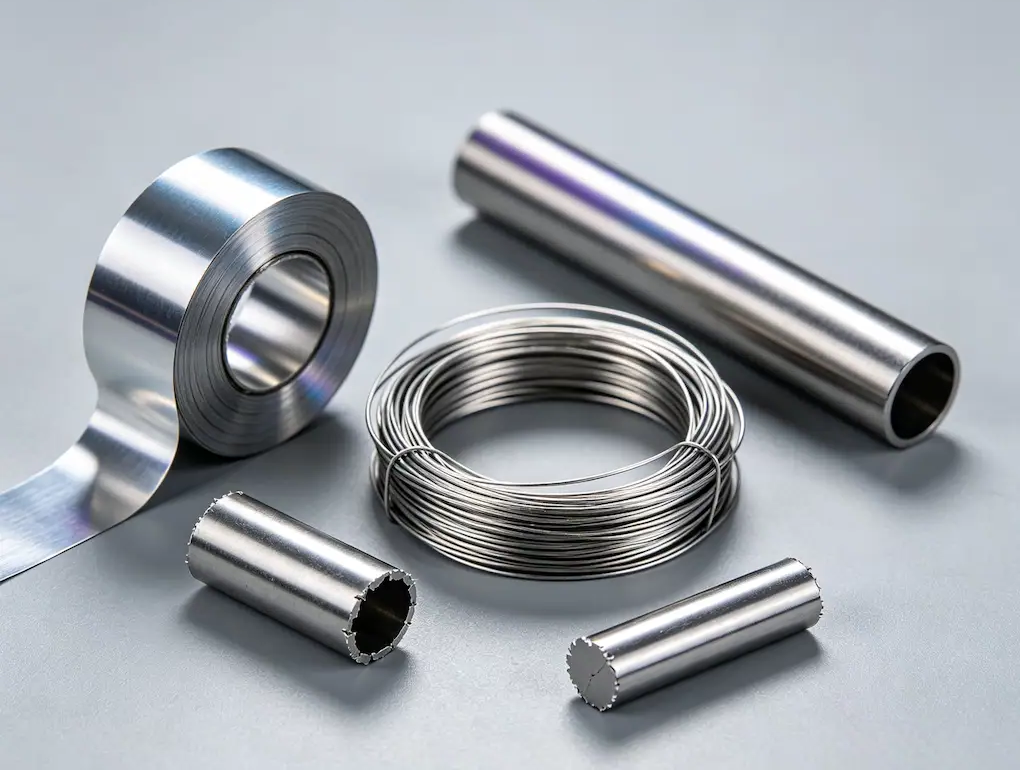
- Nitinol Alloy Wire (Superelastic & Shape Memory) – Available from macro diameters down to ELI Ultra-Low Inclusion Micro-Wires for high-fatigue medical components.
- Nitinol Ribbon & Flat Wire – Rectangular and precision flat cross-sections designed for continuous-wound braided catheter shafts.
- Nitinol Tubing (Standard & Seamless Micro-Tubes) – High-precision medical-grade tubes with tight OD/ID tolerances; including custom oval and shaped profiles.
- Nitinol Sheet, Strip & Thin Foil – Ranging from ultra-thin foils 0.01mm to 0.1mm to plates engineered for low-temperature or high-temperature applications.
- Nitinol Round Bars & Forging Blocks – Centerless ground, polished round and square bars featuring high chemical homogeneity for heavy industrial machining.
- Nitinol Forged Ingots & Granules – High-purity bulk raw material for custom rolling, re-melting, and vacuum alloying.
4.2: Precision Springs & Actuators (Kinetic Components)
Targeting: Robotics, automotive, aerospace engineers, and mechanical OEMs.
- Nitinol Compression Springs – Programmed to expand or push outward predictably when heated past their customized threshold.
- Nitinol Extension & Tension Springs – Delivers constant elastic return force and extreme deformation recovery at ambient/room temperatures.
- Nitinol Torsional & Custom Actuator Springs – One-way memory kinetic parts engineered to replace solenoids in smart valves and thermal switches.
- Custom CNC Bent Wire Forms – Specialized 2D/3D OEM geometries, shape-set to client blueprints for consumer goods (e.g., breakproof eyewear frames).
- Nitinol Sealing Snap Rings & Gaskets – High-resilience fasteners maintaining constant radial sealing pressure across extreme thermal-cycling ranges.
4.3: Minimally Invasive Medical Device Components (Interventional Raw Materials)
Targeting: Medical device R&D engineers, contract manufacturers, and clinical OEMs.
- Self-Expandable Vascular & Urological Stents – Biocompatible, kink-resistant structural implants engineered for reliable endovascular placement.
- Laser-Cut Nitinol Stent Tubes – High-precision micro-machined blanks with complex slot patterns ready for secondary electropolishing and expansion.
- Nitinol Orthodontic Archwires – Pre-shaped dental arches generating gentle, continuous, and highly predictable tooth-movement forces.
- Pt-Cored Radiopaque Guide Wires – Composite wires featuring a platinum core wrapped in Nitinol for excellent X-ray fluoroscopy visibility.
- Minimally Invasive Biopsy Graspers & Grippers – Micro-machined endoscope claws and flexible tool tips capable of navigating tortuous anatomy.
- Neurovascular Embolization Coils – Ultra-soft micro-coils customized for delicate and safe aneurysm occlusion.
- Catheter Inner Shafts & Pushrods – Provides advanced pushability and high torque transmissibility for navigation systems.
4.4: Nitinol Powders for Additive Manufacturing & Sintering
Targeting: 3D printing service bureaus, medical implant manufacturers, and research universities.
- 3D Printing Grade Spherical Nitinol Powder – Gas-atomized with high flowability, optimized for Laser Powder Bed Fusion and Direct Energy Deposition.
- Low-Oxygen Medical Grade Spherical Nitinol Powder 15-53 microns – Specifically processed to minimize brittle oxide inclusions during metal 3D printing.
- Nitinol Spherical Powder Low-Oxygen Medical Grade 45-106 microns – Tailored to print structures that mimic human bone elasticity, significantly improving osseointegration.
- Industrial Sintering Grade Fine Nitinol Powder – Cost-effective, high-mesh powder optimized for traditional powder metallurgy and porous filter manufacturing